The Harris family had been looking for over eight months. Two houses had finally made the shortlist — and they were almost too different to compare.
The choice
Property A was a four-bedroom Victorian semi in Croydon. Larger garden, bigger bedrooms, a kitchen extension done well. The asking price was £485,000. There was one problem: it sat about 400 metres outside the published catchment boundary for the local outstanding-rated primary school.
Property B was a three-bedroom 1970s terrace, clearly inside the catchment. Smaller in every dimension, no extension, needs a new bathroom. £462,000. But their daughter could walk to the school they'd set their hearts on.
They'd talked it to death. They'd walked both streets twice. They'd found three different online catchment maps that didn't agree with each other. They put both Rightmove URLs into HomesToCompare and asked the AI to work through it.
What the AI surfaced
The catchment boundary problem
The AI flagged something they hadn't thought to ask: the catchment boundary for oversubscribed schools is redrawn almost every year based on where successful applicants lived. The 400-metre gap wasn't a permanent fact — it was last year's number. In a growing area, it can shrink. It can also grow. The AI recommended they call the local authority admissions team directly and ask for the last three years' admission distances, not just the current one.
They called. In each of the past three years the furthest admitted applicant had lived between 280 and 420 metres from the school. Property A was at risk in two of those three years.
The space question, properly costed
Property A's extra bedroom wasn't just comfort — it was a letting option if they needed it. The AI pulled the local rental comparables context and noted that a fourth bedroom in that postcode typically adds £200–£300 per month to rental value. It also noted the extension had added value that wasn't fully reflected in the asking price relative to comparable three-bed unrenovated stock.
The clause they hadn't read
Under buyer guidance, the AI highlighted that Property B's title register likely contained an estate management clause common to 1970s local authority-built stock in the area — specifically, a right-to-buy-back provision that had been exercised on three nearby properties in the last decade. It suggested asking the seller's solicitor to confirm whether this clause existed and whether it had ever been triggered on this specific title.
It had. The clause existed. It had never been triggered, but it was there — and the current council had tightened its use of the provision in 2023. Their solicitor confirmed this was a material fact that needed disclosing in their offer considerations.
The decision
They offered on Property A. The school question remained a calculated risk, but with eyes open: they understood the boundary was variable, not fixed, and that the admissions team confirmed the trend had been widening slightly over three years. They negotiated £11,000 off the asking price using the comparative analysis as a basis. Their daughter started at the school the following September — Property A was inside the catchment that year.
They wouldn't have asked about the title clause without the AI flagging it. They nearly bought Property B without knowing it existed.
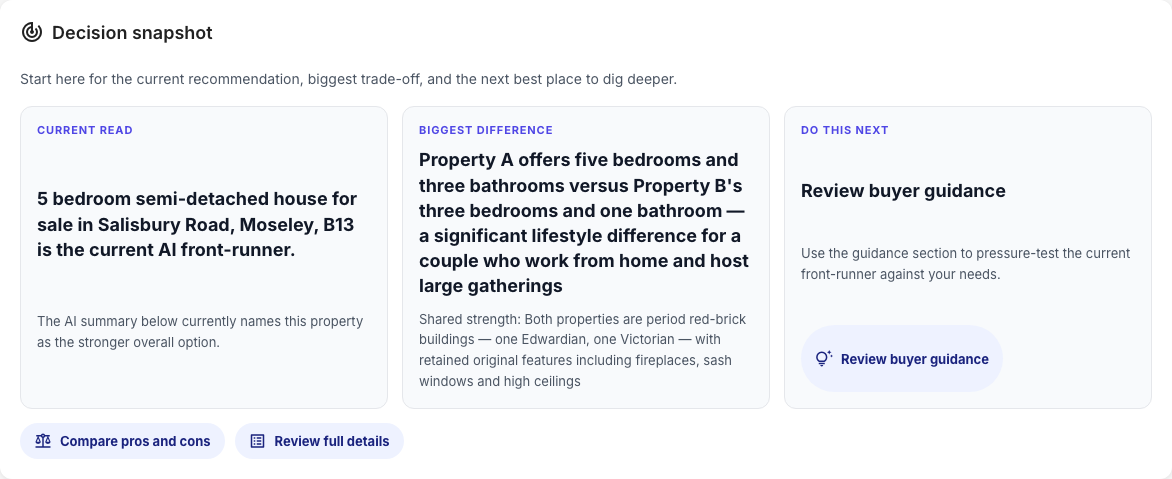
Have two properties you're weighing up? Put the URLs in and see what the AI surfaces.
Compare your shortlistThe buyers in this story are illustrative composites, and the figures are realistic examples rather than a specific transaction. The checks and trade-offs described are the ones a real comparison surfaces.